Blueberry Funded Review 2026
The exact plan matters more than the funded-account label: simulated capital, loss calculations, active days and withdrawal conditions.
Official sources checked 2026-10-31 · 13 min read

For account comparisons, see the best CFD prop firms guide.
This is an independent, documentation-based review, not a firsthand Blueberry account or payout test. I do not claim a Blueberry partnership. SATO VIP is my own paid service. Firm rules, available plans and purchase-date terms can change; confirm them before paying.
Blueberry Funded offers simulated trading programs with evaluation and instant paths. The reviewed 1-Step plan combines a 10% evaluation target with a 4% daily loss limit and 6% static maximum loss limit; Instant Elite uses a different trailing structure. The main checks are your exact plan, trade-idea restrictions and reward conditions—not a generic promise of fast funding or guaranteed payouts.
This Blueberry Funded review focuses on the forex/CFD-side programs documented in its official help centre. The website also links to a Futures destination and synthetic products; those are not treated as the same account or independently reviewed here. If you trade ES or NQ, do not assume an index symbol on a CFD platform is the CME futures contract you already know.
Blueberry Funded review: what the funded account actually is
The firm’s official website identifies Blueberry Markets (SVG) LLC as the operator and says its challenges offer virtual accounts. The Instant Elite guide is explicit: fees buy access to a simulated trading environment and evaluation framework, no real capital is allocated, and no investment services are provided under that program.
That distinction matters. A nominal account allocation describes the simulation and its permitted loss limits; it is not money deposited in a brokerage account in your name. A performance reward is payable under the firm’s contract and compliance requirements. It is not automatically withdrawable simply because a trading dashboard shows profit.
The broker-backed description may help identify the business relationship, but it does not by itself establish that challenge fees have client-money protection or that every prop account is a regulated brokerage account. The footer says amounts paid for challenges are not client money. Read the actual contracting entity and terms rather than importing protections from a separate broker service.
My review does not certify the firm’s finances, its reported aggregate payouts or future ability to pay. Public documentation is a useful starting point; it is not an audit. The prop-firm due-diligence checklist gives a broader way to evaluate counterparty and contract risk.
1-Step, Flex and Prime are not interchangeable
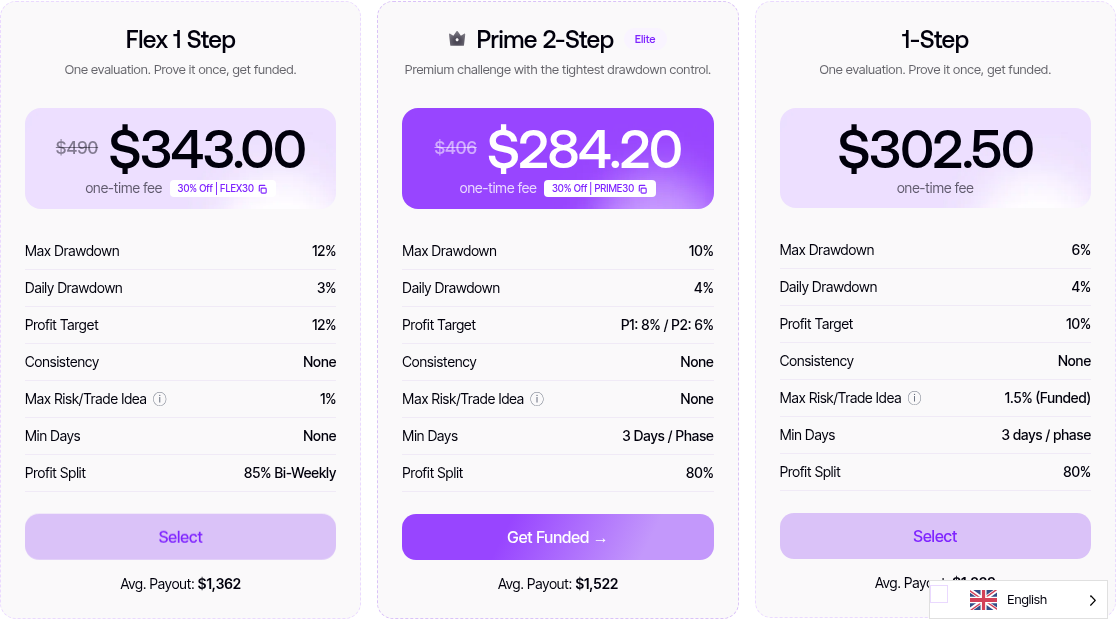
The homepage currently separates an evaluation model, an instant model and synthetic-index offerings. Its evaluation cards include Flex 1 Step, Prime 2-Step and 1-Step. Similar names do not mean similar rules: the official 1-Step guide specifically redirects Flex holders to a different rules article.
The homepage’s Flex card lists a 12% target, 12% maximum drawdown, 3% daily drawdown and a 1% trade-idea limit. Prime’s card lists targets of 8% and 6% across its two phases, a 10% maximum drawdown and 4% daily drawdown. These are headline parameters from the cards, not complete calculation rules or a recommendation.
For the rest of this review, the detailed numerical examples use the standard 1-Step guide because its calculations and earning-stage restrictions are documented clearly. Do not apply those numbers to Flex, Prime, an instant plan, a legacy purchase or a synthetic account.
Check the exact product label in your checkout and order confirmation. Save the purchase-date rulebook, any add-ons and the refund or reset conditions before paying. If two official pages appear to disagree, obtain written clarification instead of choosing the version that gives more room.
The standard 1-Step evaluation: target and active days
The current 1-Step guide lists a 10% profit target and at least three active trading days. A day counts only if it closes at least 0.5% of initial account balance in realised profit. Simply opening a trade or making a small profit does not necessarily produce a qualifying day.
On an illustrative $50,000 allocation, 0.5% is $250. A day that closes $80 profit may improve the total balance but does not meet that active-day threshold under the reviewed rule. Treat the threshold as a condition to check, not a daily earnings objective you should force with additional trades.
The guide states there is no maximum trading-day limit, but it also has a 30-day inactivity rule. You must open and close at least one trade within that window to keep the account active. No deadline to pass is therefore different from permission to leave the account untouched indefinitely.
After meeting the objectives, qualification remains conditional on compliance. The website describes signing a trader contract and completing KYC before the earning stage. Hitting the target does not bypass identity, permitted-strategy or account-review requirements.
Daily loss and maximum loss: two floors to monitor
For the reviewed 1-Step plan, maximum drawdown is static at 6% of initial account size. The guide says neither equity nor balance may hit or fall below that floor. On a $100,000 allocation, the static floor is $94,000, even if the balance later grows to $120,000.
The daily limit is different: a fixed amount equal to 4% of initial balance is subtracted from the higher of balance or equity at the daily reset. In the firm’s example, a $100,000 initial account with $102,000 equity at the reset has a $98,000 daily floor: $102,000 minus $4,000. It is not simply 4% of whichever headline balance you happen to see intraday.
The help centre describes the reset as 5:00 PM EST. Confirm the dashboard’s actual reset clock and daylight-saving treatment instead of manually assuming a year-round local-time conversion. Floating positions across the reset can affect the reference used for the next daily limit.
You must respect both floors. Having room above the static maximum-loss level does not rescue a daily breach, and being profitable for the week does not excuse equity crossing today’s floor. Use an internal risk budget well below the permitted limit rather than trading right up to it.
The earning-stage trade-idea rule changes the risk budget
The reviewed guide adds a 1.5% risk-per-trade-idea restriction to standard 1-Step earning accounts under the post-March 12, 2026 rules. It does not apply to that plan’s evaluation phase. That phase difference is important: a method that fits the challenge can become non-compliant after qualification.
The firm aggregates split positions belonging to the same idea. It also groups a loss followed by a new position within ten minutes in the same direction on the same instrument or a correlated instrument. Opening several smaller tickets is therefore not a way to create several independent loss allowances.
In the guide’s $100,000 example, losses of $600, $500 and $400 across one idea total $1,500, reaching the 1.5% threshold and causing a breach. Likewise, losing $900 and then $600 on the qualifying re-entry can reach that same limit. Plan comfortably below it, including costs and possible slippage.
The guide says merged or scaled accounts remain subject to the rule calculated from initial account size. Confirm how the firm records your initial allocation and correlated instruments. Do not assume a larger displayed balance automatically increases the allowed trade-idea loss.
Blueberry Funded payouts: eligibility is not settlement
For the reviewed standard 1-Step earning account, the guide lists an 80% reward split, at least $100 in realised profit, three active days within the reward cycle and continued rule compliance. The standard request cycle is fourteen days. Seven-day and on-demand add-ons alter the timing under their own conditions.
Three active days are not simply three calendar days after activation. Each qualifying day must meet the plan’s profit requirement, and the account must remain compliant. Do not take unnecessary trades just to accelerate the cycle or advertise fourteen days as a guaranteed first-payment date.
The reward-request instructions explain the dashboard process and plan-specific conditions. Separate the first eligible request, the firm’s review, approval and payment settlement. Homepage claims about payment speed describe the firm’s marketing, not an independently verified service level in this review.
I do not show a personal Blueberry payout because this article does not establish one. My own payout evidence concerns my trading at other firms and cannot validate this firm’s rewards. When reviewing member reports, look for the plan, purchase date, request date, completed payment and any dispute context—not only a funded certificate.
News, weekend holding and copier permissions
The official news policy restricts trade openings and closures and pending-order triggers during the two minutes before and after high-impact releases. Its stated restrictions also include modifications. Read the full instrument-specific application before leaving a position or order exposed to an announcement.
This can conflict with a method built around news volatility or rapid order adjustment. Ask how stop-loss or take-profit executions are treated and which calendar determines the event. A generic statement that you never manually enter during news is not enough if an existing order can trigger inside the restricted window.
The standard 1-Step table lists weekend trading as allowed, but permission is not risk removal. Check instrument hours, gaps, spread behaviour and daily-reset mechanics. Separate that permission from rules for a different plan or program.
The guide allows copying between your own user accounts and rejects third-party account copying. It also permits EAs subject to the prohibited-strategy policy. Neither statement verifies a specific software connection. My Tradecopia workflow is for my own futures accounts; this article does not establish that the same copier works with Blueberry’s reviewed CFD programs.
Instant Elite uses a different drawdown model
The Instant Elite guide describes immediate access to a simulated funded account without an evaluation or profit target. It lists no daily drawdown limit, but a 10% trailing maximum drawdown that locks at the starting balance. Skipping a challenge does not mean the account has no loss constraints.
A trailing floor can move as the reference balance grows. The relevant question is what makes it trail, when it locks and how withdrawals interact with remaining room. Do not import the standard 1-Step static-floor example into this plan simply because both accounts are called funded.
Instant Elite also has its own active-day and reward conditions. No evaluation target is different from immediate unconditional reward eligibility. Read its complete guide before comparing the purchase fee against a challenge fee or assuming the instant path is easier for your strategy.
The broader account-breach overview notes plan and purchase-date differences. If you own a pre-March 12, 2026 account, the linked legacy rules may apply. Current advertising is not proof that your old contract changed.
Platforms, products and the ES/NQ distinction
Confirm the platforms available for your exact account, country and current checkout. Historical mentions of MT4, MT5 or DXtrade are not sufficient to establish every option today. I have not connected or placed a trade on a Blueberry account as part of this review.
The homepage lists FX, metals, indices, crypto, energies and synthetic indices. A simulated CFD index instrument is not interchangeable with a CME E-mini contract. Contract size, pricing, financing, execution and volume data need their own checks; a familiar market name does not make an ES or NQ futures strategy portable without adjustment.
My execution is TradingView connected to Tradovate, with ExoCharts for orderflow. I use that stack on my futures prop accounts, not as a claimed Blueberry platform test. If your priority is exchange-traded futures, read futures versus forex before buying a CFD-side product.
Likewise, synthetic indices are a separate product category. Their always-on marketing does not establish the same market mechanics as exchange-traded ES or NQ. This review does not evaluate synthetic strategies or Blueberry’s separate Futures destination.
Costs, resets and scaling: read beyond the advertised fee
The screenshot captures the firm’s own displayed plan prices and promotions on October 31. I do not turn those into an evergreen price list, a SATO offer or a claim about the cheapest provider. Checkout amounts, currency, taxes, add-ons and regional availability can change.
Before paying, record the total charge, what happens after a breach, whether a reset is available, whether it restarts a phase or the whole evaluation, and the refund conditions. The website advertises reset options, but a reset is not assumed to be free or available for every situation.
The scaling article describes conditional increases for evaluation-path earning accounts and excludes instant accounts. Treat scaling as a future conditional possibility, not capital already allocated at purchase. Check the required performance and completed rewards, plus how risk calculations change, before making it part of a plan.
Budget repeated attempts honestly. Several modest fees can become a material expense without producing an eligible reward. A lower advertised challenge fee is not necessarily better value if its active-day or trade-idea rules clash with the way you already trade.
My verdict: compare the contract with your actual method
The useful feature here is access to detailed public plan guides, including worked drawdown and trade-idea examples. That lets a trader check a strategy against the rules before buying. Standard 1-Step’s static maximum-loss floor is straightforward to calculate once you also understand the separate daily floor.
The trade-offs are meaningful: active-day profit thresholds, news restrictions, earning-stage aggregation of related losses and plan-specific reward timing. No consistency rule or no maximum evaluation deadline removes none of those constraints. A rules-compatible strategy matters more than an attractive account label.
I would not call Blueberry universally safe, easy or preferable on the evidence here. I have not independently tested its platform, payouts or financial strength. For a comparison, use the CFD prop firm guide and inspect each firm’s current contract, not just target percentages.
If you are coming from futures, do the product and data comparison first. If you already trade CFDs, check the precise news and trade-idea constraints against your journal. Either way, do not change a functioning risk process merely to reach a reward window sooner.
Official sources and checks still outstanding
- Current homepage, plan cards and operator disclosure
- Standard 1-Step: objectives, loss calculations and earning-stage rules
- Instant Elite: simulated status and trailing limits
- High-impact news restrictions and trading rules and prohibited practices
- Reward-request process and conditional scaling
Checked October 31, 2026. Live platform access, exact regional checkout availability, settlement times and personal Blueberry payouts remain unverified. This review cites the firm’s published rules rather than presenting them as independently tested operations.
Last updated 2026-10-31. Verify the exact plan and purchase-date rulebook; documented terms and backtests do not guarantee results.
Blueberry Funded Review FAQ
Is Blueberry Funded legit?+
Its official site identifies the operator and publishes detailed account rules. That supports due diligence, not a guarantee of solvency or payouts. This is a non-partner, documentation-based review; Sato's own payouts do not verify Blueberry Funded.
Does Blueberry Funded provide a live brokerage account?+
The reviewed guides describe simulated accounts. The Instant Elite guide explicitly says no real capital is allocated. A performance reward from simulated trading is not the same as a withdrawal from your own live brokerage balance.
Is 1-Step the same as Flex 1-Step?+
No. Blueberry's official 1-Step guide says it does not apply to Flex 1-Step. The homepage lists different targets, loss limits and trade-idea rules, so read the guide for your exact plan.
What are the Blueberry Funded 1-Step rules?+
The current guide lists a 10% evaluation target, 4% daily loss limit, 6% static maximum loss limit and three active days. An active day needs at least 0.5% of initial balance in closed realised profit. Older purchase-date rules may differ.
Does the 1-Step earning account have a consistency rule?+
The reviewed guide states no consistency rule, but the earning stage still has a 1.5% risk-per-trade-idea limit, active-day requirements, loss limits and prohibited-strategy rules. No consistency rule does not mean unrestricted trading.
How often can I request a 1-Step reward?+
The reviewed guide lists a standard 14-day cycle, an 80% split, at least $100 realised profit and three active days in the reward cycle. Seven-day and on-demand add-ons have separate conditions. Eligibility is not guaranteed settlement.
Can I trade high-impact news?+
The official policy restricts opening and closing trades and pending-order triggers in the two minutes before and after high-impact releases, including stated modification restrictions. Confirm the exact instrument and plan application before trading.
Can I copy trades between my own Blueberry accounts?+
The 1-Step guide permits copying between your own user accounts but not third-party accounts. Check the current prohibited-strategy policy as well. This review does not verify a particular copier's compatibility or permission.
How does Instant Elite drawdown differ?+
The reviewed Instant Elite guide lists a 10% trailing maximum drawdown that locks at the initial balance and no daily drawdown limit. It is not the static 6% maximum-loss structure of the reviewed 1-Step plan.
Does Sato have a Blueberry Funded discount code?+
No Blueberry Funded partnership or Sato discount code is claimed here. The screenshot shows Blueberry's own advertised offers at capture time, not a permanent price or a Sato promotion.