Best Futures Prop Firms in 2026
Updated June 24, 2026 · 18 min read

Disclosure: Some links in this article are affiliate links. SATO Trades may earn a commission at no extra cost to you. We only rank firms we personally trade and trust.
There are dozens of futures prop firms in 2026, but only a handful are worth your evaluation fee if you trade ES, NQ, or other CME futures contracts. This ranking is written from the perspective of a real funded futures trader — passed evaluations, taken payouts, and watched the industry shift from forex-first prop firms to futures-first prop firms over the last two years.
We're keeping this list intentionally tight. Three firms. Tradeify, FundedNext Futures, and Apex Trader Funding — the firms most worth your attention in 2026 for serious futures traders who care about staying funded and getting paid, not just passing the cheapest challenge. Use the SATO discount code for the best available offer plus access to free funded-account giveaways on the SATO Trades livestream.
One important note up front: this ranking is built around long-term profitability, not the size of a one-off sticker discount. The cheapest challenge is rarely the cheapest path to ongoing payouts.
Skip ahead — jump straight to a partner firm
Best available discount · Free giveaway entry · Cancel anytime
The best futures prop firms at a glance
| Firm | Rank | Drawdown Type | Payout Speed | Model | Drawdown | Payouts | Best For |
|---|---|---|---|---|---|---|---|
| FundedNext Futures | 🥇 #1 Overall | End of day (no daily loss limit) | 3–5 trading days | Flex, Legacy, Rapid — three challenge styles | EOD max loss across Flex, Legacy, and Rapid, no daily loss limit | 3-day cycle on Rapid, 5-day on Flex/Legacy, up to 95% reward share | Traders prioritizing long-term payouts and EOD drawdown without DLL |
| Tradeify | 🥈 #2 Overall | End of day, locks at threshold | Daily after threshold | Select (eval) + Lightning Funded (instant) | End-of-day, locks at profit threshold | Daily payouts on Select after threshold, 90% split | Long-term ES / NQ traders who want clean rules and zero activation fees |
| Apex Trader Funding | 🥉 #3 Overall | EOD Trail or Intraday Trail | Every 5 trading days | Single-step, EOD Trail or Intraday Trail (new products) | EOD Trail or Intraday Trail, 50% consistency on PA | Every 5 trading days, 100% requested rewards, max 6 per account | Traders running many accounts and chasing deep promo pricing |
Pricing, drawdown, and payout rules change frequently. Apex relaunched its product line on March 1, 2026 with new EOD drawdown options and simplified rules — always confirm the current details on each firm's official site before buying.
Ranking Methodology
Every firm in this list was scored on six factors that actually matter to a funded futures trader who wants to keep getting paid:
- Long-term cost — evaluation cost, activation fees, reset fees, and the realistic total to reach and stay funded.
- Drawdown model — EOD vs intraday trailing, and how punishing it is in normal trading conditions on ES and NQ.
- Rules clarity — how easy it is to understand profit targets, drawdown, daily loss limits, and consistency rules without parsing pages of fine print.
- Payout sustainability — payout speed, profit split, minimum trading days, payout caps, and whether the structure rewards traders for staying funded for years.
- Trader experience — platform support (NinjaTrader, Tradovate, Rithmic, WealthCharts), data feeds, dashboard, and support quality.
- Scaling — number of accounts allowed, account size ladder, and the long-term path from one funded account to real trading income.
For the bigger picture on how funded accounts work, see our complete 2026 guide to getting a funded trading account.
#1 — FundedNext Futures (Best Overall Futures Prop Firm 2026)
FundedNext is one of the most established names in the broader prop firm world (over $321M in payouts, 71k+ Trustpilot reviews, ~44 hour average processing time), and their FundedNext Futures product has matured into the best overall futures prop firm on this list.
What pushes FundedNext to the top of this update is the actual structure of their funded accounts — particularly Flex and Legacy. Both use EOD max loss with no daily loss limit, and Flex requires no buffer before you can withdraw. If your goal is long-term payouts, those are exactly the rules you want.
FundedNext Legacy
Legacy is FundedNext's "highest return per reward cycle" model and the choice for traders who want maximum profit per withdrawal.
- Consistency rule during challenge — applies while you're proving the account. Keeps you from passing on one outlier day.
- No consistency rule in funded phase — once you're funded, big days don't block payouts.
- No daily loss limit — you manage your own daily risk.
- No buffer required to withdraw — you don't need to build a cushion before requesting your first payout.
- Benchmark trading days — a minimum trading-day requirement before each reward cycle.
- Withdrawal structure — payouts on a 5-day cycle with no daily-loss-limit interference.
Why long-term traders prefer Legacy: it gives you the largest "per cycle" payout in the FundedNext lineup, without forcing you to babysit a buffer or a daily loss limit. That makes it a strong fit for swing-style or higher-conviction futures traders.
FundedNext Flex
Flex is, in many futures traders' opinions, one of the most attractive funded-account structures currently available — and the cheapest entry point in the FundedNext lineup (starts at $79.99 for the 50K).
- Lower profit targets than evaluation alternatives — easier to pass.
- No daily loss limit in either phase.
- No buffer rule — withdraw without building up a cushion first.
- EOD trailing drawdown — drawdown updates at the close, not intraday.
- Consistency rule applies during challenge only — once funded, no consistency restriction.
- Reward share up to 95% with the free Flex add-on.
- Maximum withdrawal per cycle equal to the max loss limit — designed for steady, repeated withdrawals.
Why Flex stands out for futures traders: the combination of EOD drawdown + no DLL + no buffer + 95% split means you can focus on actually trading instead of fighting the rulebook. Many traders treat Flex as their primary long-term account specifically because the rules don't get in the way of staying funded.
Legacy vs Flex — which fits which trader?
- Pick Legacy if you want the largest single withdrawal per cycle and don't mind a slightly higher entry price. Best for traders with higher per-trade conviction and lower trade frequency.
- Pick Flex if you want the absolute cheapest entry, the highest reward share (95%), and a structure that rewards consistent, repeated withdrawals without a buffer. Best for day traders and scalpers on ES, NQ, MES, MNQ.
- Flex, Legacy, and Rapid all use EOD max loss with no daily loss limit
- Flex requires no consistency after funding — up to 95% reward share
- Legacy has no consistency rule in the funded phase and $6,000 max withdrawal per cycle
- Rapid pays every 3 trading days — the fastest cycle in the lineup
- Three account models (Flex, Legacy, Rapid) for different trading styles
- $321M+ in payouts, 71k+ Trustpilot reviews — major operator
- No activation fees on any model
- Rules vary by model — pick carefully, don't assume Flex rules apply to Rapid
- Flex withdrawal cap is $1,500 per cycle — best for smaller frequent payouts
- Rapid Pro withdrawal cap is $1,200 per cycle — Legacy needed for larger payouts
#2 — Tradeify (Best for Simple Rules & Zero Activation Fees)
Tradeify remains, in my opinion, the strongest runner-up in 2026 — and the gap actually narrows when you stop ranking firms on raw sticker price and start ranking them on what it costs to get funded, stay funded, and keep withdrawing.
The headline points: no activation fee, end-of-day drawdown that doesn't punish you for giving back unrealized profits, daily payouts on Select plans once thresholds are hit, and 90% profit split. The pricing you see at checkout is what you pay — no $69 or $99 activation surprise after you pass. That single difference alone changes the math of running multiple Tradeify accounts long term.
Tradeify also keeps the rulebook genuinely short. Single-step Tradeify Select with a clear profit target, max loss, daily loss limit, and no time limit. Or skip the evaluation entirely with Lightning Funded instant-funded accounts. For ES and NQ day traders specifically, this is the cleanest experience on the market — sizing around the daily loss limit is straightforward, the platform list (Tradovate, NinjaTrader, WealthCharts, TradeSea) covers everything serious futures traders actually use, and you're not fighting a moving intraday trailing number while you trade.
Tradeify runs regular promotions and the SATO discount code unlocks the best available offer for SATO Trades readers — going through the SATO partner link also makes you eligible for the free funded-account giveaways we run on livestream.
- No activation fee — what you see is what you pay
- End-of-day drawdown that locks in (friendlier than intraday trailing)
- Daily payouts on Select after threshold; 90% profit split
- Single-step evaluation with no time limit, plus Lightning Funded instant option
- Excellent platform & data feed support (Tradovate, NinjaTrader, WealthCharts, TradeSea)
- Best long-term experience for ES, NQ, MES, MNQ traders
- $250M+ in verified payouts to date
- Not the lowest sticker price — Apex wins on raw promo pricing
- Lower account-count cap than Apex's 20-account model
- Consistency rule still applies — outsized single days can delay payouts
#3 — Apex Trader Funding (Best for Promo Pricing & Scaling)
Apex Trader Funding is the largest and most well-known futures prop firm in the industry, and the relaunch on March 1, 2026 cleaned up several long-standing complaints — most notably the EOD drawdown option, the removal of the MAE and 5/1 risk-reward rules, and the explicit "no payout denials" policy.
Apex still wins on two things almost no one else matches: raw promo pricing (the 25K eval is $199 sticker but routinely drops to ~$19.90 in coupon promos) and scaling (up to 20 funded accounts per trader). For traders who treat prop trading like a business — running many accounts and taking smaller, frequent payouts — Apex is hard to beat.
The trade-off is real complexity. Apex's new product line offers both EOD Trail and Intraday Trail drawdown variants, with a 50% consistency rule on PA (Performance Account) accounts, a daily loss limit on funded accounts, a cap of 6 payout requests per account, a one-time $69 activation fee per PA, and a 7-day window to activate after passing. Eval accounts are one-time fees (no rebill) and expire after 30 days with no resets — so the cost math depends on how many tries you need to pass.
Drawdown details on Apex are easy to mis-remember. On Intraday Trail, the drawdown threshold follows your highest unrealized equity intraday. On EOD Trail, it updates at the close. Either way, the model is workable once you size correctly — but it's notably more rules to internalize than Tradeify or FundedNext Flex.
- Cheapest sticker price in the industry during frequent promos (often ~$19.90 for a 25K eval)
- Up to 20 funded accounts per trader — best scaling in the industry
- Account sizes from $25K to $150K (and larger via packs)
- 100% requested rewards in Sim Funded — no payout split deduction
- 5 trading days between payouts; no payout denials policy
- Now offers both EOD Trail and Intraday Trail drawdown variants
- One-time eval fee (no recurring billing) on new products
- $69 activation fee per Performance Account stacks up quickly across multiple accounts
- Eval expires after 30 days and cannot be reset — you re-buy if you don't pass in time
- Max 6 payout requests per account caps long-term earning per single account
- More rules and edge cases than Tradeify or FundedNext Flex — higher learning curve
- Activating 20 accounts requires real capital and real risk management to actually scale
Total Cost to Reach (and Stay) Funded
Most traders shop for prop firms by sticker price and ignore the fees that show up after they pass. Activation fees, reset fees, monthly rebills, and payout caps add up fast — especially if you're running multiple accounts.
| Firm / Model | Eval Fee | Activation | Monthly | Reset | Estimated Total |
|---|---|---|---|---|---|
| Tradeify Select (50K) | ~$95 with SATO (35% off) | $0 | $0 (one-time) | Discounted reset add-on | ~$95 to funded |
| FundedNext Flex (50K) | $79.99 (often discounted further) | $0 | $0 (one-time) | ~$60–$80 reset | ~$80–$160 to funded |
| Apex Intraday Trail (25K) | $199 sticker, often ~$19.90 in promos | $69 (PA activation) | $0 (one-time eval, no rebill) | N/A — eval expires in 30 days, no resets | ~$89–$268 per account to funded |
All numbers are based on current public pricing at the time of writing. Promotions move constantly — confirm at checkout.
Tradeify's no-activation-fee structure is a real, durable cost advantage. If you fund a single account, the difference is small. If you scale to 5–10 accounts over a year, the activation savings alone fund several extra evaluations.
Apex activation costs ($69 per PA) are the single most under-discussed cost in the industry. A trader who buys ten 25K evals on a deep promo at $19.90 each pays ~$199 in eval fees — and then $690 more in activation fees to actually fund all ten accounts. That's the real entry cost.
FundedNext costs sit between the two: cheap eval fees on Flex, no activation fee, and modest reset costs. Over a year, FundedNext and Tradeify are very competitive on total cost; Apex wins on sticker, loses on activation, and wins again when you're spreading across many accounts.
The real question is value over time, not the price tag on day one. The next two sections break that down.
Long-Term Funded Account Comparison
Once you're funded, the rules of the funded account — not the evaluation — decide how much you actually take home. Ranking the most common long-term funded-account structures:
- 🥇 FundedNext Flex Funded — EOD max loss, no DLL, no buffer, up to 95% reward share. Arguably the most trader-friendly structure on the list; the obvious choice if you want to maximize reward share and don't need 20 accounts.
- 🥈 Tradeify Funded — EOD drawdown that locks at a threshold, no activation fee, daily payouts on Select, 90% split. Best balance of simplicity and sustainability for a single long-term account.
- 🥉 FundedNext Legacy Funded — no DLL, no consistency after passing, no buffer. Best when you want the largest per-cycle withdrawal and trade with higher conviction.
- 4. Apex PA / Sim Funded — 100% requested rewards, 5-day cycle, max 6 payout requests per account. Excellent reward share, but the per-account payout cap means scaling Apex realistically means scaling across many accounts, not one big account.
The ranking reflects payout sustainability and rule simplicity first, scaling second. If your priority is "I want one or two accounts I never have to think about again," Tradeify and FundedNext Flex are the answer. If your priority is "I want a business with 10–20 accounts," Apex earns its spot.
What I Would Choose If I Were Starting Today
If I were a brand-new futures trader sitting down today with $500 to allocate to my first evaluation, this is exactly what I'd do — and what I tell traders in the SATO community when they ask.
Start with one account, not ten. Most traders fail their first evaluation not because the rules were too hard, but because they bought five accounts during a promo, traded all of them with the same setup, and lost the same trade five times. The cheapest path to funded is one disciplined account that you actually respect.
My first pick would be Tradeify Select (50K) with the SATO discount. No activation fee, EOD drawdown, single-step pass, no time pressure. If you want a backup model, add a FundedNext Flex (50K) for the EOD + no-DLL + 95% reward share combination. Those two accounts cover almost every futures-trading style without requiring you to learn two different rulebooks at the same time.
Why most traders fail evaluations: not the rules. Over-sizing, revenge trading, trading every session instead of the one they're best at, and treating the eval like a casino instead of a job interview. Risk per trade above 1% of account size is the fastest way to blow a 25K or 50K account on a normal NQ wick.
Staying funded is a different sport than passing. The mindset that gets you to a funded account ("hit the target") is the opposite of the mindset that keeps you funded ("don't hit the max loss"). I size smaller after passing, not bigger.
Payout consistency > payout size. Ten $500 payouts in a row builds a real funded-trading habit. One $5,000 payout that empties a buffer and sets you up for a max-loss the next week is how most traders lose accounts. The firms that rank highest here (Tradeify, FundedNext Flex / Legacy) are the firms whose rules naturally support the first pattern.
Personal Trader Notes
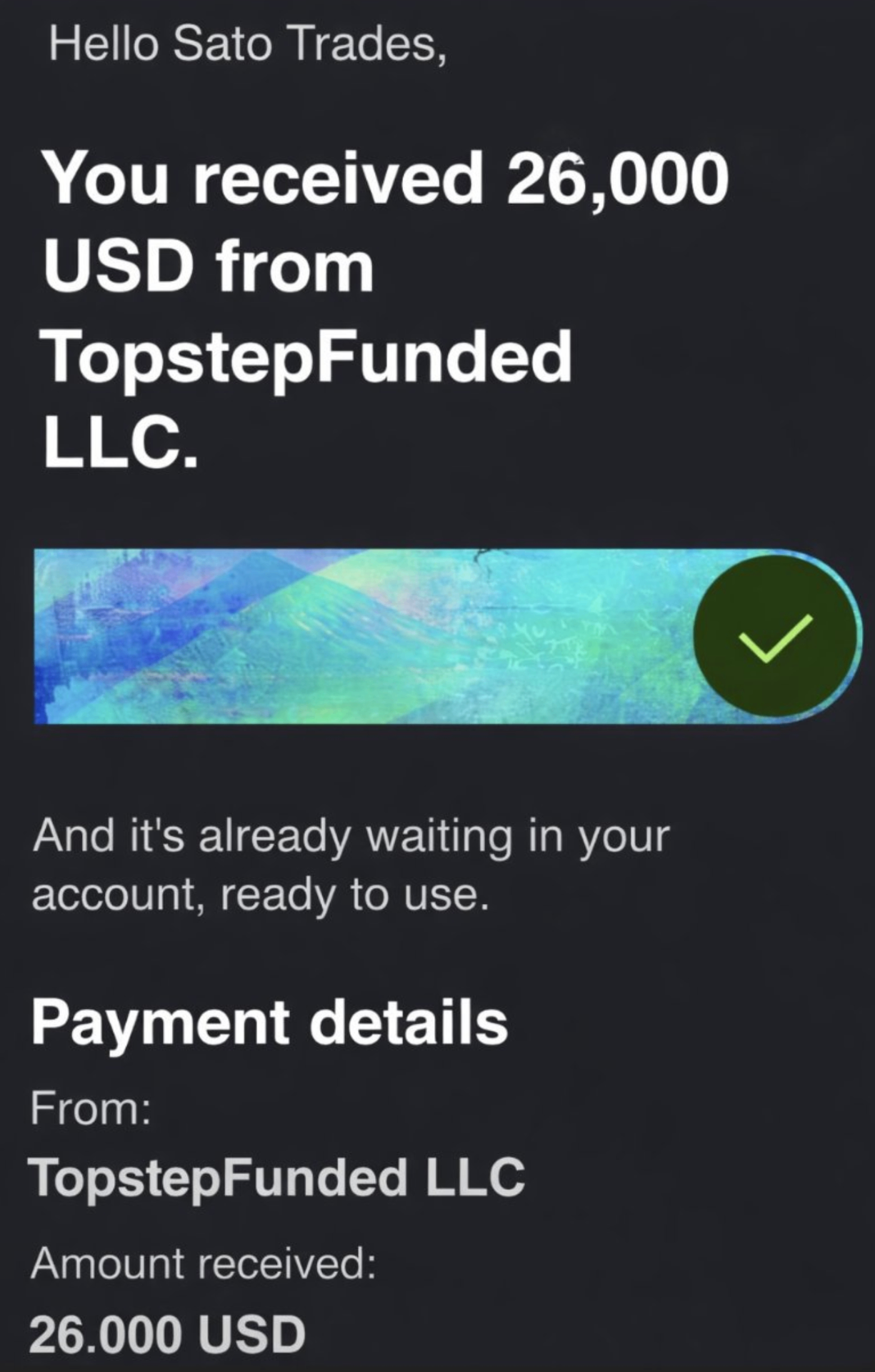
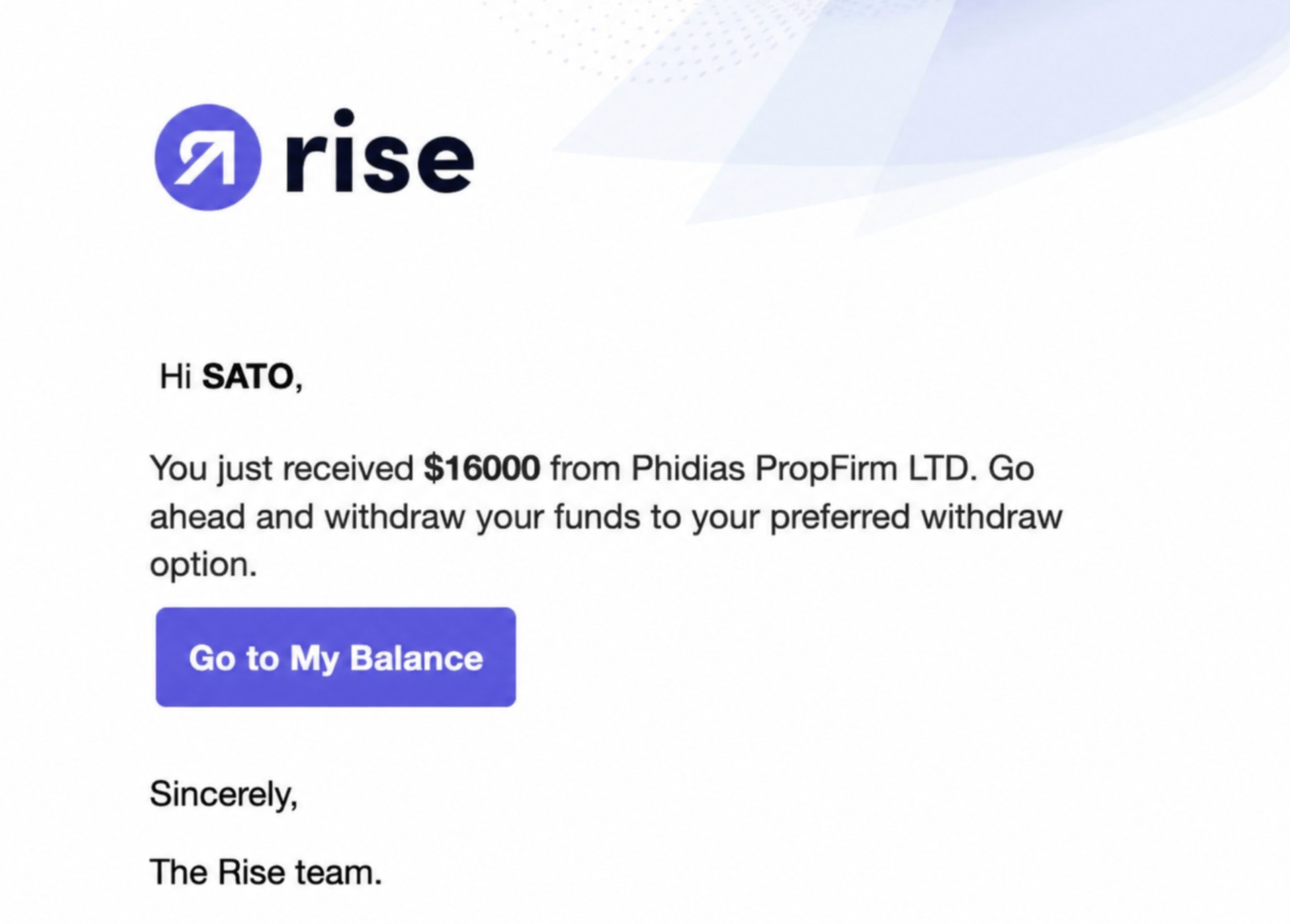
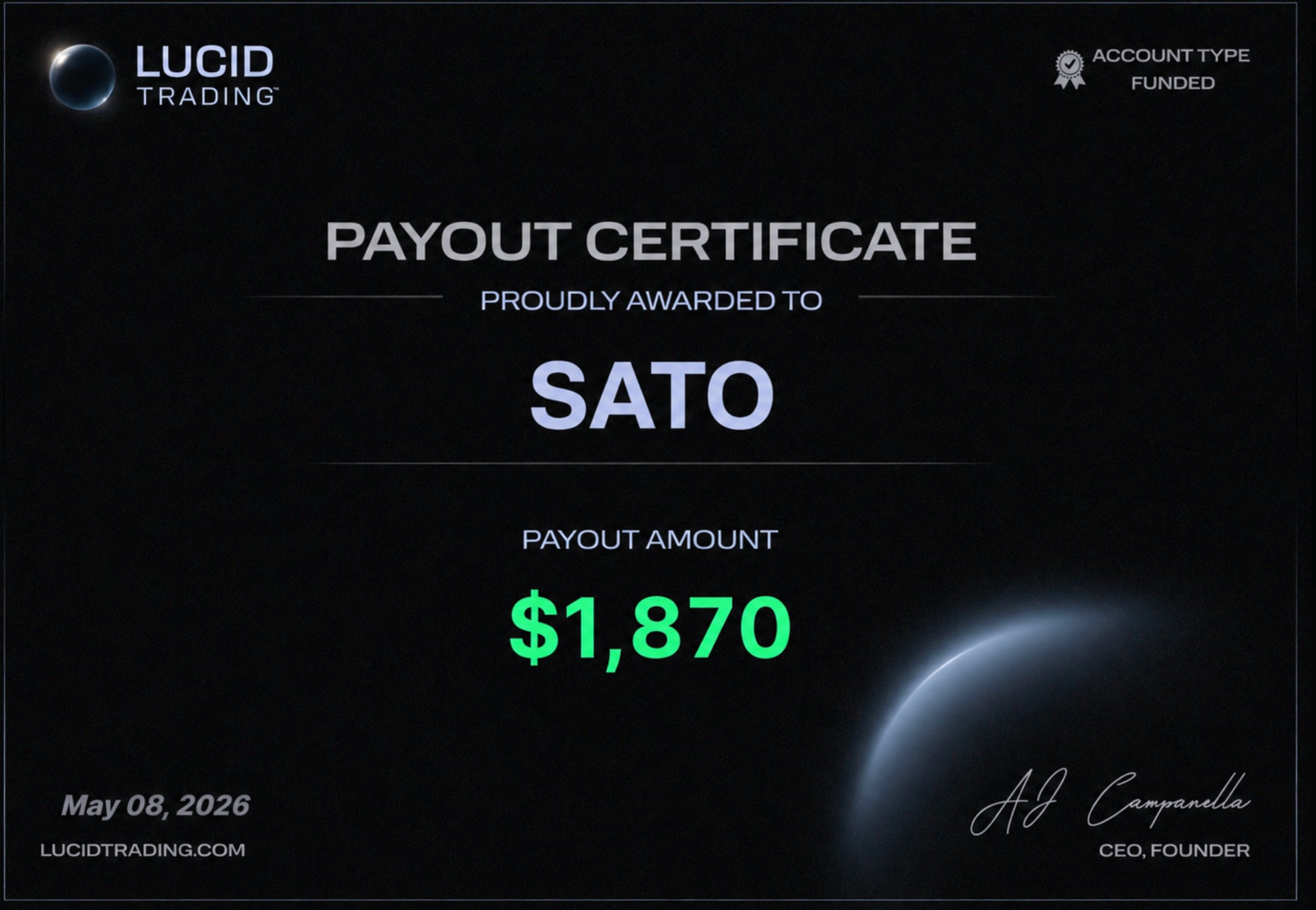
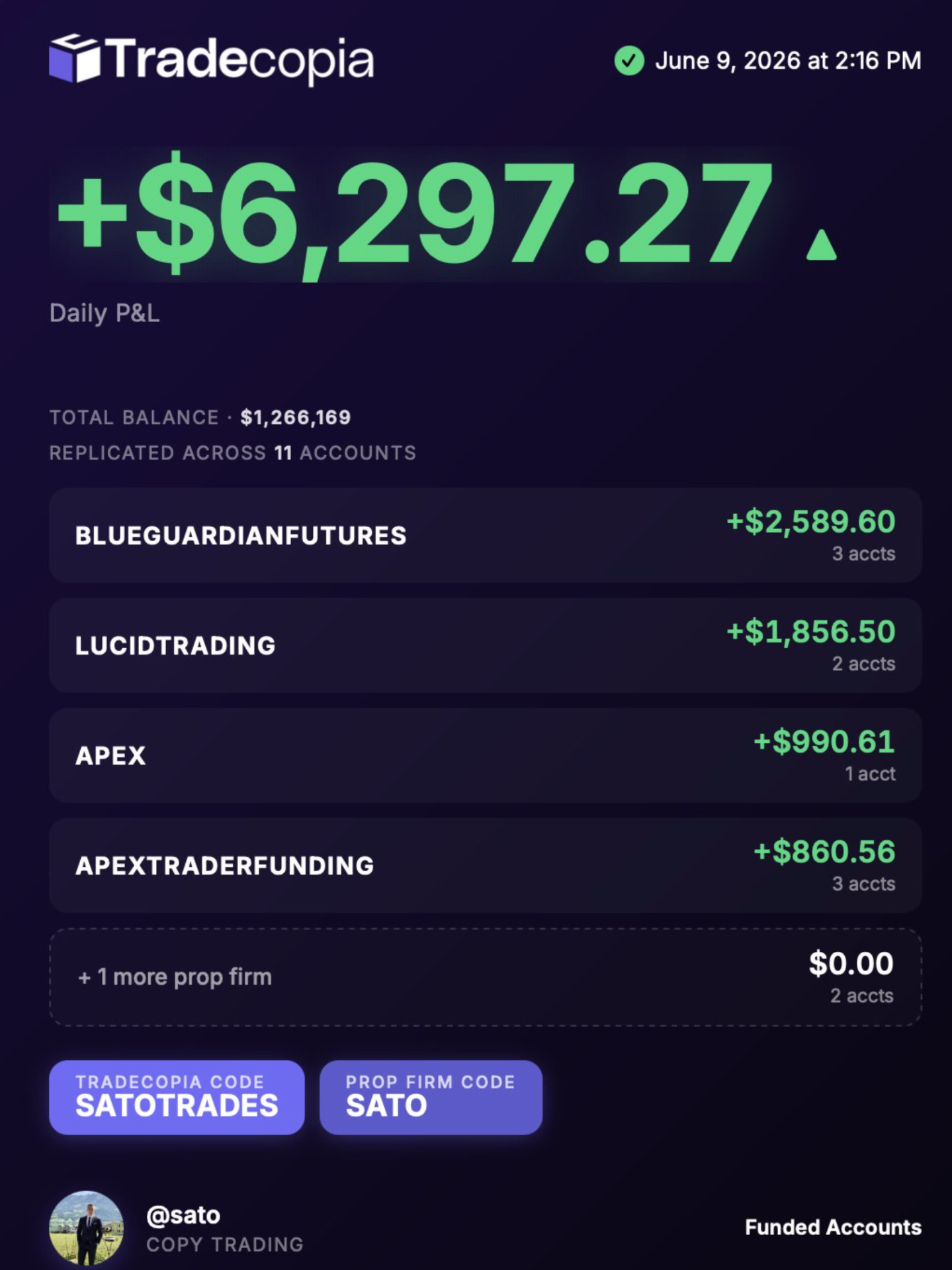
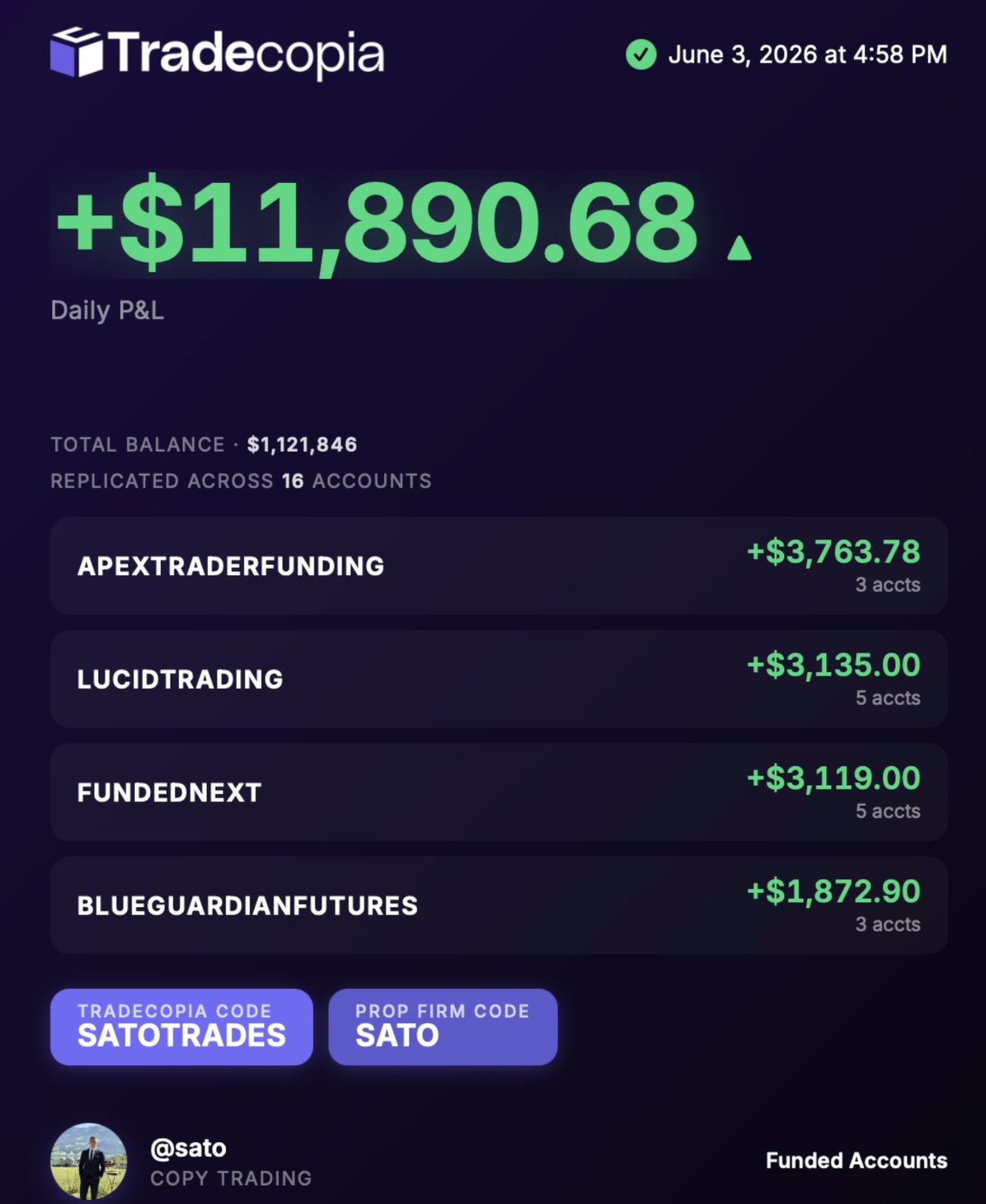
These are my verified funded-trader payouts — real screenshots from real prop firm accounts, dated and documented on the SATO Trades Payout Proof page.
My Thoughts on Flex, Legacy and Rapid Accounts
FundedNext now runs three futures account structures — Flex, Legacy, and Rapid — and the right choice depends on how you trade, not which one is "cheapest" at checkout. (The old Bolt challenge has been discontinued.)
Flex
Flex is, frankly, one of the best-designed funded futures structures I've seen this year. A $2,500 profit target, $1,500 EOD max loss, no DLL, up to 95% reward share, and the lowest entry price in the FundedNext lineup. Max withdrawal is $1,500 per cycle, which suits traders who prefer smaller, more frequent payouts. For most ES and NQ day traders, Flex is the easiest answer to "which one do I buy?" — and it pairs naturally with a Tradeify Select account as a two-firm long-term setup.
Legacy
Legacy is the model I default-recommend to traders who plan to be funded for years, not months. A $3,000 profit target, $2,000 EOD max loss, 80% reward share, and a $6,000 maximum withdrawal per cycle — the largest per-cycle payout in the lineup. No daily loss limit and no consistency rule in the funded phase means the account behaves like a real prop trading account, not a compliance obstacle course. Long-term traders prefer Legacy when they want bigger single payouts rather than the highest split percentage.
Rapid
Rapid is built for speed: pass fast, first reward in 3 trading days on Rapid Pro, no DLL, and consistency only applies after funding (40%). Rapid Pro pays 90% with a $1,200 max withdrawal per cycle; a Rapid Daily variant also exists for traders who want daily-cycle rewards. Compared to Legacy and Flex, Rapid is more "sprint to first payout" than "marathon to long-term income" — useful, but not what I'd build a multi-year funded plan around.
No model on this list is wrong. They're tools. Pick the tool that matches how often you trade, how much you withdraw per cycle, and how long you plan to hold the account.
What Actually Matters (And What Doesn't)
Most traders shopping for a futures prop firm focus on the wrong things. Watch how prop firm decisions usually get made on Twitter and Discord:
- Which evaluation is cheapest this weekend?
- Which firm has the biggest discount code?
- Which firm gives the biggest account size for the lowest price?
Those are the questions that drive impulse buys, not long-term funded trading. The questions that actually matter:
- How easy is it to stay funded on this firm's drawdown model?
- How often will I actually receive payouts, and how big can they be?
- Does the drawdown punish me for normal ES / NQ intraday volatility?
- Does the firm's rule set support good risk management, or fight against it?
- Is the cost per year of funded trading low — or just cheap on day one?
When you re-rank firms by those questions, the order in this guide stops being controversial. Tradeify and FundedNext Flex / Legacy reward long-term funded traders; Apex rewards traders willing to scale into many accounts and play the promo game. Both are valid. One is more sustainable than the other for most readers.
Which Futures Prop Firm Is Best for You?
The honest answer depends on how you trade and how aggressively you want to scale. Here's the quick decision framework I use when funded traders ask:
- You want simple rules, no activation fee, and the cleanest long-term experience → Tradeify. Best for ES and NQ day traders, scalpers, and beginners.
- You want EOD drawdown, no DLL, and the highest reward share → FundedNext Flex (or Legacy). Best when you want long-term payouts without rule-friction.
- You want maximum scaling, deep promo pricing, and run prop trading like a business → Apex. Best when you can absorb activation fees and you're comfortable with the rule complexity.
Whichever firm you pick, the rules and discipline that actually get you funded are the same. Our complete funded trading account guide walks through the exact playbook used to pass evaluations and take consistent payouts.
Best Futures Prop Firm for ES and NQ Traders
If you primarily trade the S&P 500 (ES / MES) and Nasdaq-100 (NQ / MNQ) futures — which is most of the SATO Trades audience — the ranking sharpens a little.
Tradeify is the best for ES/NQ traders who want EOD-style drawdown that doesn't punish you for giving back unrealized profits on a fast NQ reversal. FundedNext Flex is right there with it — EOD max loss, no DLL, and a 95% reward share that adds up over a year of NQ scalping. Apex works well for ES/NQ scaling once you've internalized the trailing math and are running multiple accounts.
All three support MES and MNQ micros, so you can size precisely on smaller account tiers and graduate to ES / NQ minis on the larger ones.
Get the SATO Discount + Free Giveaways
Going through the SATO Trades partner links and using code SATO at checkout unlocks the best available discount on Tradeify and FundedNext — and makes you eligible for the free funded-account giveaways we run live on the SATO Trades YouTube stream.
See real payouts from SATO traders on our Payout Proof page, or browse all partner prop firms.
Frequently Asked Questions
What is the best futures prop firm in 2026?+
For most ES and NQ futures traders in 2026, FundedNext Futures is the best overall futures prop firm — especially the Flex and Legacy models — because of EOD drawdown, no daily loss limit, and up to 95% reward share. Tradeify is the strongest runner-up thanks to simple single-step rules, no activation fee, end-of-day drawdown, and daily payouts on Select plans. Apex Trader Funding is best when you want to scale up to 20 accounts and take advantage of deep promo pricing.
Which futures prop firm has the easiest evaluation?+
Tradeify Select has one of the most beginner-friendly single-step evaluations: clear profit target, max loss, daily loss limit, no deadline, and no activation fee. FundedNext Flex is similar in feel — single-step with EOD max loss and no daily loss limit. Apex is also single-step and can be passed in a day, but the trailing drawdown variants catch new traders off guard if they don't size correctly.
What is the cheapest futures prop firm?+
Apex Trader Funding is typically the cheapest sticker price during their frequent promotions (often 80–90% off the $199 25K eval), but a $69 activation fee per account and 6-payout cap reset the math. FundedNext Flex starts at $79.99 for the 50K and Tradeify runs the SATO discount of 35% off — both have no activation fee, which often makes them cheaper to actually get and stay funded.
Can I trade ES and NQ on all three firms?+
Yes. Tradeify, FundedNext Futures, and Apex all support the major CME index futures including ES, MES, NQ, MNQ. They also support energy (CL, MCL), metals (GC, MGC), and currency futures.
Which prop firm pays the fastest?+
All three firms process payouts within days. FundedNext publishes an average ~44 hour processing time and many traders report payouts in hours. Tradeify offers daily payouts on Select plans once thresholds are met. Apex pays every 5 trading days. SATO Trades documents real payouts from partner firms on the Payout Proof page.
Do I need to use code SATO?+
Yes — to get the best available discount on Tradeify and FundedNext, use the SATO Trades affiliate links and enter code SATO at checkout. Using the SATO links also makes you eligible for free live giveaways on the SATO Trades YouTube stream.
Trailing vs end-of-day drawdown — which is better long term?+
End-of-day (EOD) drawdown is friendlier for long-term funded trading because the loss limit only updates at the close — you don't get stopped out by giving back unrealized profits intraday. Tradeify uses EOD drawdown. FundedNext Flex and Legacy use EOD max loss. Apex now offers both EOD Trail and Intraday Trail variants on new accounts; the EOD option is the more sustainable choice for most traders.
How many funded accounts can I have?+
Apex allows up to 20 funded accounts per trader — the most aggressive scaling in the industry. Tradeify and FundedNext allow multiple accounts as well but with lower caps. Most traders are better off mastering one or two accounts before scaling.
Last Updated
This ranking was last updated on June 24, 2026. Prop firm pricing, drawdown rules, and promotions change frequently — we re-check the official Tradeify, FundedNext Futures, and Apex Trader Funding pages regularly (Apex relaunched their product line on March 1, 2026). If you spot something out of date, ping us in the SATO Trades community and we'll refresh it.
Related Guides
- ComparisonCFD vs Futures Prop Firms (2026)Instruments, costs, rules and payouts — which funded account type fits your style.
- ReviewTradeify Review 2026Deep dive on the #2 ranked firm — rules, payouts, and real experience.
- ComparisonApex vs Tradeify: Which Is Better in 2026?Head-to-head on pricing, drawdown, payouts, and scaling.
- PlaybookHow to Get a Funded Trading Account (Complete 2026 Guide)The exact path from evaluation to first payout — rules, sizing, mindset.
- Getting FundedInstant Funding Prop Firms 2026Are instant funding plans worth it? Honest breakdown of cost, rules, and which firms are legit.
- ReviewTopstep Review 2026Honest breakdown of the oldest name in futures prop trading — and where it falls short in 2026.
- RulesTrailing Drawdown Explained (2026)Why the drawdown model matters more than the price of the evaluation.
- RulesProp Firm Consistency Rule ExplainedHow consistency rules work at each firm — and how to not fail one.
- RulesApex Trader Funding Rules (2026 Rulebook)Every current Apex rule in one place, including the March 2026 relaunch.
- ReviewFundedNext Futures Review 2026Flex vs Legacy vs Rapid on the #1 ranked firm, with payout proof.
- PayoutsHow Long Do Prop Firm Payouts Take?Real payout timelines by firm, from request to money in your account.
- CostsCheapest Prop Firms in 2026True total cost to get funded once resets and activation fees are counted.