Prop Firm Copy Trading: What's Allowed and How to Scale Safely
Yes — most reputable futures prop firms allow copy trading across your own accounts ( Tradeify, Apex, FundedNext, Lucid, Blue Guardian), as long as you are the trader on the master account. Below: the firms that allow it, the rules you can't break, and how I copy traded one ES futures short into $11,890 across four funded accounts in a single session.
Updated June 28, 2026 · 18 min read

Disclosure: Some links in this article are affiliate links. SATO Trades may earn a commission at no extra cost to you. Every firm and tool mentioned is one I personally trade with, test, or believe genuinely serves futures traders. Trading futures involves substantial risk of loss.
Watch the live session this article breaks down.
- One ES futures short, executed once on a master account, mirrored to four funded prop firms via Tradecopia. Combined P&L for the session was $11,890.
- Entry was a re-short of the prior day's 30-minute resistance around 7628, with a stop at 7646.75 and the target down at the 7580 orderflow level (R:R 3.45).
- The signal was bearish absorption at the highs. Big resting offers, plenty of buyers stepping in, and price refusing to break up through the high-volume node.
- Scaling means running the same disciplined trade across multiple funded accounts so one execution produces multiple payouts. Apex $3,700, Lucid $3,100, FundedNext $3,100, Blue Guardian ~$2,000.
- A trade copier is the bridge between your master account and the rest of the portfolio. Without it, this kind of multi-account result is basically impossible to execute by hand.
The $11,890 Case Study, By the Numbers
This was one trade. A short on ES that I took live on stream right around the U.S. cash open and held into the afternoon. The same fill ran on four prop firms through Tradecopia, which is the only reason the total looks the way it does. Without the copier I would have made a normal day on one account. With it, the same setup paid across the whole portfolio.
Here is how the day actually split across the funded accounts I was running:
| Prop Firm | Role | Day P/L |
|---|---|---|
| Apex Trader Funding | Copier follower | $3,700 |
| Lucid Trading | Copier follower | $3,100 |
| FundedNext Futures | Copier follower | $3,100 |
| Blue Guardian | Copier follower | ~$2,000 |
| Total (one ES short, ~3.4 hours) | $11,890 | |
Real session breakdown from the live YouTube stream. Contract sizing varies per firm based on account size and rules.
What Scaling Prop Firm Accounts Actually Means
Scaling in the prop firm world means running the same disciplined strategy across multiple funded accounts at the same time. It's the institutional model — one trader, one edge, multiple books — adapted to retail futures traders who lease capital from prop firms instead of allocating their own.
The math is simple and brutal in both directions:
- 1 account, 2 contracts: a 10-point ES move = $1,000 day.
- 5 accounts, 2 contracts each: the same move = $5,000 day.
- 5 accounts, losing 8 points: the same mistake = $4,000 loss across the portfolio.
Scaling is not a strategy. It is account architecture wrapped around a strategy. If your edge is positive, scaling magnifies the income. If your edge is negative, scaling magnifies the bleed. Most failed scalers never had an edge in the first place — the second account just exposed it faster.
Copy Trading & Trade Copiers Explained
A trade copier is a piece of software that listens for fills on a designated master account and replicates them on one or more follower accounts in real time. For futures prop firms, this usually runs through NinjaTrader, Quantower, or a Tradovate API layer.
The mechanics are straightforward: when you submit an order on the master, the copier forwards an equivalent order to each follower with a configurable contract multiplier. Sub-100ms latency is normal on a properly configured setup, which means slippage between master and follower accounts is usually one tick or less on a liquid contract like ES.
- Mirrors entries, exits, and stop adjustments across all accounts simultaneously.
- Scales contract size automatically per account based on a fixed ratio or risk-based formula.
- Lets you enforce identical execution across every account without retyping orders.
- Fix a losing strategy — it scales results, good or bad.
- Bypass a firm's rules. Daily loss, trailing drawdown, and contract limits still apply per account.
- Protect against correlation risk — every account takes the same hit when you're wrong.
The trade copier I personally use: Tradecopia
Tradecopia is the copier running behind every scaled session you see on my livestreams. Reliable multi-account futures copying, clean per-account contract sizing, and fast enough that follower fills stay within a tick of the master on ES.
Why ES Futures Is the Ideal Vehicle
The E-mini S&P 500 (ES) is the most liquid equity index futures contract in the world. For a scaled prop firm portfolio, that liquidity matters far more than people realize. When you're filling 15 to 20 contracts across five accounts on the same tick, you don't want a market that slips two points on entry.
| Spec | ES (E-mini S&P 500) |
|---|---|
| Tick Size | 0.25 points |
| Tick Value | $12.50 per contract |
| Point Value | $50 per contract |
| Session (CT) | 17:00 Sunday – 16:00 Friday, 60-min daily break |
| Prime Window | U.S. cash open 09:30–11:00 ET |
| Average Daily Volume | ~1.5–2M contracts |
For a deeper breakdown of why ES dominates scaled portfolios — including a comparison against NQ, YM, and CL — see our best futures prop firms guide and the broader free trading guides hub.
Full Trade Recap: The ES Short, Step by Step
I shorted ES live on the YouTube stream right around the U.S. cash open. It was a re-entry. The day before, on the previous stream, I had shorted the exact same 30-minute resistance level on ES. Price came back up to it after the open and I re-shorted the same zone, just a touch higher than the original entry.
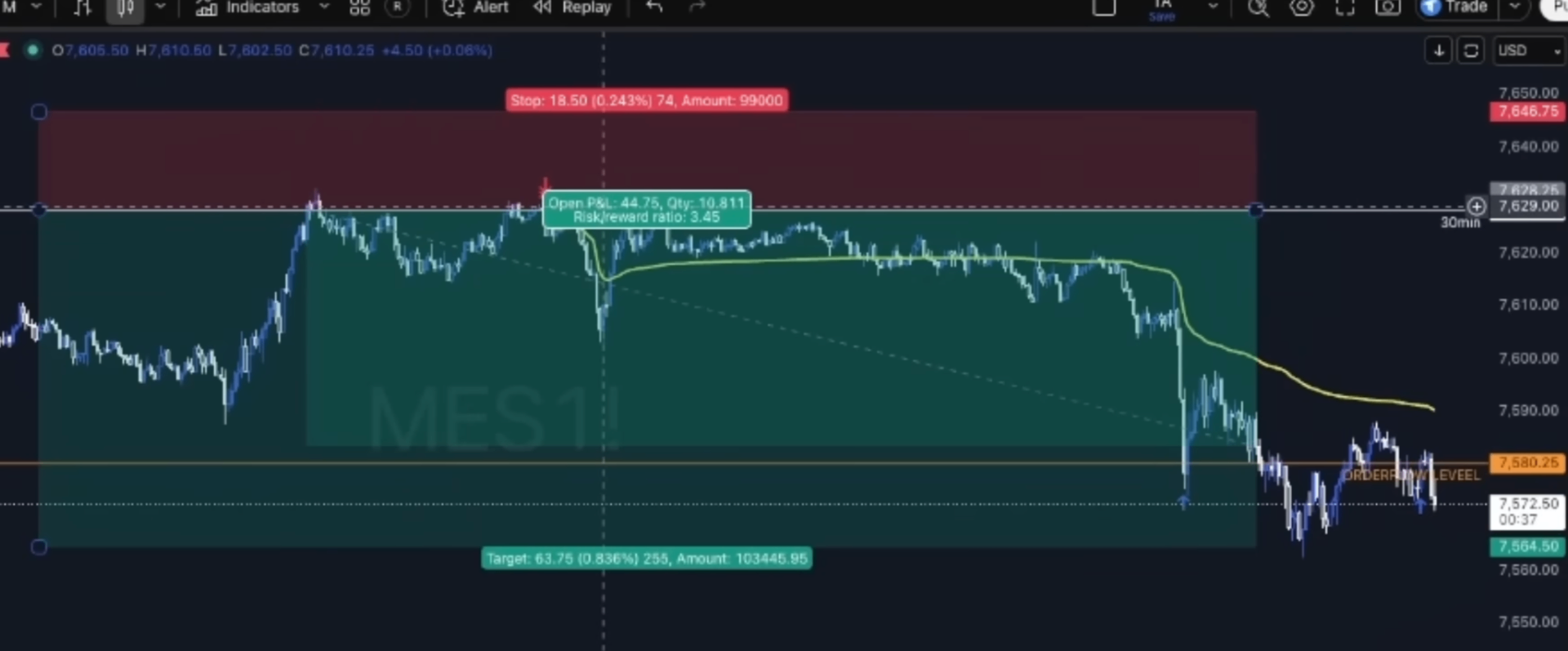
ES had been relentlessly bullish into this session, but the prior day I had already shorted the 30-minute resistance and it worked. That level was still live going into the next open. My intraday orderflow levels also flagged strong resistance and a stack of liquidity around the 7,628 area that price had visited multiple times. Plan going in: re-short the same zone if we got a push back into it.
The setup was bearish absorption. Buyers kept hitting the bid into the 7,628 high-volume node and price refused to go anywhere. We ranged around VWAP for a long stretch with aggressive buying coming in, but the tape would not push through the level. That is the classic signature of a passive seller absorbing every bid that shows up. Once you see it print over and over at the same level, the path of least resistance flips lower.
I re-entered the short around 3 to 5 minutes after the cash open at 7,624.75, since price had pushed a little above the prior stream entry. Stop went at 7,646.75, which is 18.50 points of risk on ES. Target sat down at the 7,580 orderflow level area, with the chart marker at 7,564.50 (63.75 points), giving a clean R:R of 3.45. The fill went on the master account, the copier mirrored it onto Apex, Lucid, FundedNext and Blue Guardian.
After entry we got another pump that almost tagged my entry back. I held it. The thesis had not changed and stop was still safe. Then we got the dump into the morning. Price spent the rest of the U.S. session consolidating, and I said on stream multiple times that I was still holding the short. Late in the session the market gave up and we got a massive sell-off into the close. I scaled out once on the move down and closed the rest of the position on the flush. About a 3.4 hour hold from entry to last fill. Combined P&L across the four prop firms: $11,890.
Risk Management at Scale (Non-Negotiable)
When you have one account, a bad trade is annoying. When you have five, a bad trade hits like a freight train. Scaled risk management isn't optional — it's the entire difference between a trader who runs a portfolio for years and one who blows it in one bad session.
My personal rule on a $50K account is around a 20 point stop on MES with 2 contracts. That works out to roughly $200 of risk per trade, which keeps me well inside any trailing drawdown. The copier preserves that ratio across accounts because contract size is scaled per follower, not copied 1:1 from the master. Same percentage risk on every account, regardless of size.
Set a portfolio-level daily loss cap below what any single firm enforces. Mine: two losing trades or 1.5R total, whichever hits first. The copier shuts off, all accounts flat, day done. No revenge trading possible — the platform is closed.
Each firm uses a different drawdown mechanic — end-of-day trailing, intraday trailing, static after lock. Know which type applies to every account before stacking. The free trading guides cover this in detail.
Most firms cap total open contracts across all accounts under one trader. Exceeding it can void payouts even if no individual account broke a rule. Always pull the combined limit from each firm's rulebook before adding the next account.
The Trade Copier Setup, Step by Step
Here is the exact order to follow when wiring up a scaled portfolio for the first time. Don't skip steps — every line below has burned a trader who tried.
- Pass and prove one account first. At minimum, take one payout. Ideally three. Without proof of edge, the rest is theater.
- Choose a copier compatible with your platform. I personally use Tradecopia — it handles multi-account futures copying across prop firms reliably and supports per-account contract scaling out of the box. Use code SATO for 10% off. NinjaTrader users can also default to Replikanto. Always test latency on a sim account before risking funded capital.
- Designate one master account. Best practice: pick the largest funded account, since it absorbs the most slippage gracefully and signals are sized to it.
- Define per-account contract ratios. Lock these in before connecting. Example: master $150K = 5 contracts → $50K follower = 2 contracts, $100K follower = 3 contracts. Risk per follower should land in the same percentage band as the master.
- Connect on a non-trading day. Wire up accounts on a weekend or during a low-volatility session. Send test orders. Verify fills mirror across every account within one tick.
- Trade one contract on each for one week. Before stacking real size, prove the copier behaves through real session conditions — news, gaps, fast tape, partial fills.
- Scale gradually. Add one account per month at most. If a new account adds correlation risk you can't manage emotionally, stop adding.
Best Prop Firms for Scaling and Copy Trading
Not every prop firm makes scaling practical. You need clear copying policies, no hostile combined-account caps, and a payout system that won't bottleneck you when several accounts hit at once. These are the three I personally run.
Clean rules, generous trailing drawdown, fast payouts. My most-used firm for scaling.
Read Tradeify review →Industry standard for multi-account scaling. 90% off promos make stacking accounts financially efficient.
Apex vs Tradeify →Legacy and Flex accounts shine for long-term scaled portfolios. No consistency rule after funding on Legacy.
FundedNext review →| Firm | Copy trading allowed? | Same-IP rule | Max linked accounts |
|---|---|---|---|
| Tradeify | Yes — own accounts only | Allowed (same trader) | No hard cap |
| Apex Trader Funding | Yes — own accounts only | Allowed (same trader) | 10+ commonly used |
| FundedNext Futures | Yes — Legacy & Flex | Allowed (same trader) | No hard cap |
| Lucid Trading | Yes — own accounts only | Allowed (same trader) | No hard cap |
| Blue Guardian | Yes — own accounts only | Allowed (same trader) | No hard cap |
Rules change. Always confirm the current policy in each firm’s official rulebook before connecting a copier.
For the full ranked breakdown, see best futures prop firms in 2026. If you're brand new to evaluations, start with how to get a funded trading account.
Stack discount codes while you scale
The SATO code unlocks current pricing on Tradeify, FundedNext, Apex, and HyroTrader. Same affiliate links also qualify you for free Sato Supporter livestream giveaways.
The Psychology of Scaled Accounts
Scaling changes the emotional weight of every trade. A loss on one account stings. The same percentage loss across five accounts can rattle you out of trading the next setup correctly — which is exactly when most traders break their rules and turn a small portfolio drawdown into a catastrophic one.
The mental shifts that separate consistent scalers from blown ones:
- Trade the percentage, not the dollar. A 1R loss is a 1R loss whether it's $100 or $10,000. The dollar number is a result; the percentage is the process.
- Set the daily cap before you sit down. If you're deciding when to stop after a loss, you've already lost.
- Detach from the green days. Five-figure days feel incredible. They also recalibrate your sense of normal, which makes the next 1R loss feel disproportionate. Journal the wins as a process, not a windfall.
- Take payouts on schedule. Don't compound funded accounts indefinitely "for the next bigger payout." Pulling profit on cadence is what makes the system real.
For deeper work on this, the free trading guides hub covers tilt control and pre-market routines.
Common Mistakes — Don't Do These
If you haven't taken at least one payout, you don't have proof of edge. You have a sample. Scaling a sample blows multiple accounts in a week.
Your risk per trade per account should not change because there are more accounts. The portfolio R doesn't shrink — it multiplies. Keep the per-account R fixed.
Every firm caps total open contracts across your accounts. Breaching it can void the day's payouts at any firm, even ones where you didn't break a rule individually.
If your only firm has an outage, the entire portfolio is offline. Diversify across at least two firms once you scale past two accounts.
Bad time to add capacity to a system you're already not trusting. Add accounts after a stretch of green weeks, not as a recovery move.
Each follower account usually carries its own data fee and platform sub. Three accounts is roughly 3× the monthly cost. Net the payouts against real overhead, not gross.
Lessons From the $11,890 Session
- The setup was nothing exotic. A re-short of the prior day's 30-minute resistance, confirmed by bearish absorption at the 7,628 high-volume node. The five-figure number came from running it across four prop firms, not from a fancy strategy.
- Risk was defined before entry. Stop at 7,646.75, 18.50 points above the fill. There was no scenario where the loss could spiral, because the copier mirrored that exact stop to every follower account.
- I held through a pump that almost tagged the entry back. The thesis (bearish absorption, buyers exhausted) had not broken, so the trade stayed on. Most traders cut here. Most traders also leave the meat of the move on the table.
- Patience paid more than entry timing. The actual flush came hours after the open. If I had not been willing to sit through the chop, the same R:R 3.45 setup would have been a small scratch.
- One trade. One session. The copier did the rest. Adding a second setup for the dopamine is how good days turn into mediocre ones.
Want to see sessions like this live?
I trade prop firm accounts live on YouTube most market days and run a free Discord where the community shares trades, payouts, and setups in real time.
Frequently Asked Questions
Related Reading
- Prop Firm Payout Proof: Verified Withdrawals Compared (2026)
- Tradovate Copy Trading Setup (TradingView + TradeCopia, step by step)
- Best Futures Prop Firms in 2026 (Ranked by a Funded Trader)
- Tradeify Review 2026
- FundedNext Futures Review 2026
- Apex vs Tradeify Comparison
- How to Get a Funded Trading Account
- Free Trading Guides
SATO trades a scaled portfolio of funded futures accounts across Tradeify, FundedNext, and Apex, focused on ES orderflow. Sessions are livestreamed on YouTube, with a free community on Discord and a deeper VIP room for members. Every firm reviewed at SATO Trades is one used in live trading, not theory.