Trading Community: Learn Without Copying Trades
A useful community makes your preparation and review clearer—not your entry decisions louder. Here is how to choose one and participate without outsourcing your trading.
Updated 2026-11-11 · 10 min read

I run the free SATO Discord and SATO VIP, my own optional paid membership. This is a participation guide, not an independent ranking of my service. Futures trading involves substantial risk of loss.
A trading community is useful when it helps you explain a setup, question your assumptions and review mistakes. Choose by instrument, quality of feedback and clear access terms—not member count or winning screenshots. Start free, write your own plan before reading the room, and keep control of execution and risk.
A trading community can make a solitary routine less isolated. It can also tempt you into trades you never planned. The difference is how you use it: ask for feedback on reasoning, not permission to click buy. This guide covers participation and evaluation; for server comparisons, use my best trading Discord servers guide and day trading Discord guide.
What a trading community should actually help with
Think of a community as a place to compare observations, not combine accounts. Someone can notice a level you missed, ask why your stop sits inside ordinary noise, or help you understand a chart setting. None of that makes their next trade suitable for you.
The strongest question is specific: “I expected rejection at the prior value-area high, but price held above it. What evidence would make you abandon the rejection idea?” That invites discussion of invalidation. “Long or short?” invites a vote with no shared risk definition.
Look for replies that show their working. A chart with the instrument, session and explanation is more useful than a profit screenshot on its own. If nobody can describe what would make an idea wrong, the conversation is conviction rather than analysis.
Choose a day trading community by instrument and session
An equity swing-trading forum can be excellent and still be the wrong place for an intraday NQ question. Match the group to what you trade, how long you hold positions and when you are available. A lively discussion outside your session may be useful for review, but not for your preparation window.
For ES and NQ, relevant conversations include session structure, liquidity, economic releases, execution and funded-account constraints. You do not need every member to use your exact chart. You do need enough common context to understand why they see a level differently.
Choose one main group initially. Keep other resources for clearly different jobs, such as official platform support or a firm's current rules. A creator community is not the authoritative place to settle a payout-policy dispute.
Free vs paid: identify what changes after payment
Free discussion, public tutorials and paid daily preparation are different products. Do not assume a paywall improves the quality of every message, or that joining a paid group gives you software, exchange data or a tradable signal.
In my case, the main SATO Discord is free. All my tutorials are free on YouTube. SATO VIP is optional: I share my daily ES/NQ trade setups, orderflow levels and market bias, using my method backtested over five years. That is my analysis, not a substitute for your confirmation and risk decisions. Backtesting does not guarantee future results.
Before paying anywhere, write down the extra service you need. Is it preparation you can study before the session? Structured feedback? If the answer is only “maybe I will make more money,” the benefit is too vague to evaluate. Check the current membership terms and checkout price rather than relying on an old screenshot.
Inspect the reasoning behind the chart
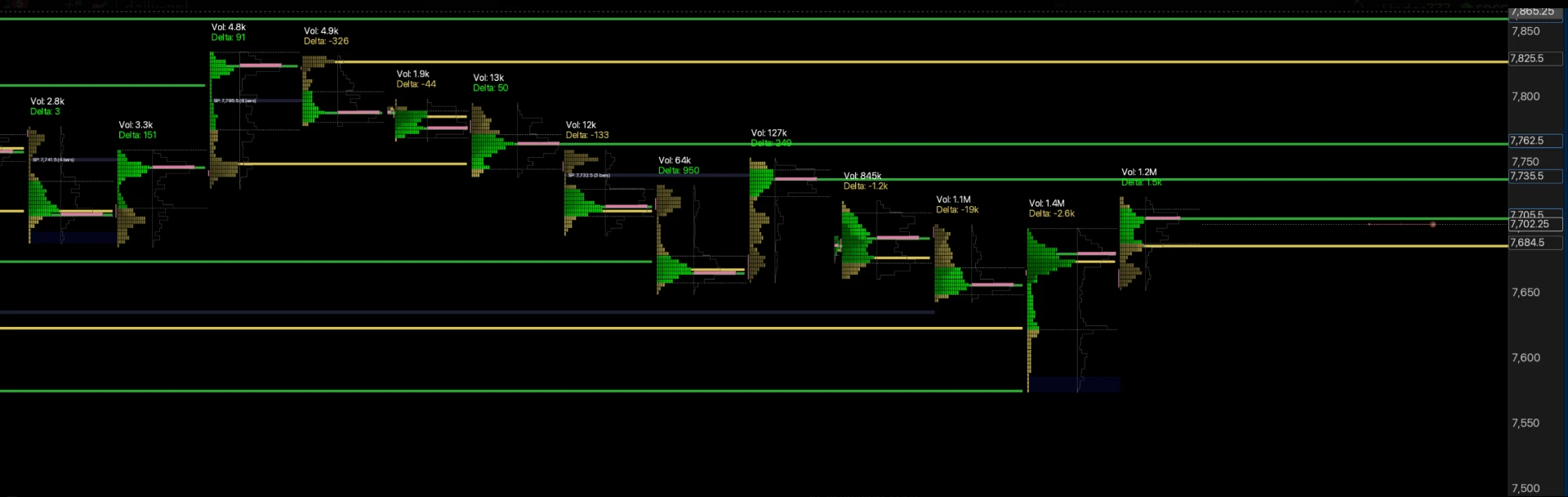
A useful discussion separates the area of interest from the decision to trade. Price reaching a marked area is only the start of the question. What did it do there? Was there acceptance, rejection or no clear response?
My own workflow uses ExoCharts for orderflow analysis and TradingView connected to Tradovate for execution. Tradecopia copies my trades across my own accounts. None of those tools or connections becomes yours by joining a community. For the chart-preparation process, read orderflow levels in TradingView.
A seven-session test before you commit
Use the following as a suggested observation period, not a membership requirement. The goal is to see whether the community changes your process in a useful way. If your trading becomes more impulsive, do not excuse it because the room is popular.
- Sessions one and two: read without trading from chat. Check whether explanations include risk and uncertainty, not just direction.
- Sessions three and four: ask one focused preparation question and one review question. Judge whether the answers address your situation.
- Sessions five and six: mute the group while executing your own plan. Return afterwards to compare reasoning, not entries.
- Session seven: review your notes. Did you follow your plan more closely, learn a concrete distinction or simply open more charts?
Do not score the test only by P&L. A profitable impulsive trade can reinforce bad behaviour. Track changes you can attribute to participation: clearer invalidation, better questions, fewer notification-driven decisions and more complete reviews.
How to ask for feedback without asking for a signal
Use a short template: instrument and session; intended idea; evidence you saw; invalidation; and the decision you want reviewed. Remove account identifiers and any information you do not want public. A chart should be readable without access to your private account.
A hypothetical example: “On ES, my plan was to watch a return to prior value. Price stayed outside it, so I skipped the fade. Did I confuse a brief touch with acceptance?” This lets someone challenge the interpretation without prescribing your next position.
Ask one question at a time. If a reply introduces a new concept, request a definition or a marked example before adopting it. A conversation that ends with a testable observation is worth more than agreement from ten strangers.
Keep community chat out of your execution window
Write your plan before opening the discussion. Otherwise another trader's confident bias can become your starting point without you noticing. You can compare views afterwards, but the original plan gives you a record of your own thinking.
During execution, mute channels that encourage reacting to every price move. Reading a late message while managing a trade can turn a planned exit into a hope-based hold. Your broker feed and your order state matter more than a delayed chat update.
If you change your view, record the market evidence that changed it. “The room went bearish” is not an invalidation condition. For a practical preparation framework, use my pre-market routine for futures evaluations.
Red flags: claims, pressure and private messages
- Guaranteed outcomes: a community cannot guarantee an evaluation pass, payout or daily profit.
- Unexplained screenshots: a balance or winning trade does not show starting capital, losses, withdrawals or typical member outcomes.
- Account-access requests: do not share passwords, authentication codes or remote access with someone offering to trade for you.
- Urgent private offers: verify support and payment links through the official site, not an unsolicited message.
- Suppressed questions: moderation can keep discussion civil, but reasonable questions about terms and risk should have understandable answers.
Report suspicious accounts through the platform and verify the official channel independently. A familiar display name is not proof of identity. Never pay someone privately because they claim to represent a community owner.
How free SATO access and optional VIP access work
Start with the free membership on Whop, then connect your Discord account there to receive the corresponding free-channel access. Saving a Discord name on this website is not the same as connecting your account on Whop.
VIP-only channels also require an active SATO VIP membership. The paid offer is daily ES/NQ preparation and setups; it does not mean there is an actionable trade every day. Gold levels are planned, but are not currently included and have no announced launch date.
For public learning before deciding, watch my free tutorials and learn from the trading recordings. I stream occasionally rather than on a fixed daily schedule. You can inspect the reasoning without waiting for a live session or purchasing VIP.
The useful outcome is a better review, not group agreement
At the end of the session, write one observation you learned and one behaviour you will test. Keep the change small enough to evaluate. Changing your strategy, platform, instrument and risk at once makes it difficult to know what helped.
A community earns its place in your routine when it makes you more independent. If you cannot take or skip a trade without checking the room, reduce your exposure and rebuild your own process first. Keep learning from others; keep the account decisions yours.
Last updated 2026-11-11. Examples are educational, not trade instructions. Public recordings and member results do not guarantee future performance.
Trading Community FAQ
What is a trading community?+
A trading community is a group where traders discuss markets, share charts and review decisions. It can run on Discord, a forum or another platform. Useful participation improves your process; it does not transfer another trader's results to your account.
How do I choose a day trading community?+
Start with your instrument and session. Look for explanations of setups, honest risk discussion, useful replies to questions and clear free versus paid boundaries. Test whether the group helps you follow your own plan rather than chase more trades.
What is the best day trading community for beginners?+
There is no universal best group. Beginners should favour understandable explanations, public learning material and a free way to inspect the community. A room focused on your instrument is more useful than a large mixed-market feed you cannot evaluate.
Is the SATO Trades community free?+
The main SATO Discord community is free to join through Whop. SATO VIP is an optional separate paid membership for my daily ES/NQ setups, orderflow levels and market bias. Tutorials are free on YouTube.
How do I get access to SATO Discord channels?+
Join through Whop, then connect your Discord account there. Free membership grants the corresponding free-channel access. VIP-only channels also require an active SATO VIP membership; connecting Discord alone does not grant paid access.
Should I pay for a trading community?+
Only if the specific additional service fits your process and budget. Inspect public material first, confirm exactly what is included and do not treat subscriptions as a way to recover trading losses. Member screenshots are not evidence of typical future results.
Is a trading community the same as a signals group?+
No. A community can focus on discussion, preparation and review. A signals service focuses on entry alerts. SATO VIP provides my analysis and setups; members decide confirmation, execution, position size and risk themselves.
Can a community help me pass a prop firm evaluation?+
It can provide feedback on preparation and rule interpretation, but it cannot guarantee a pass or payout. Check the current official rulebook and follow your own tested risk plan. Someone else's position size or copier setup may not fit your account.
How many trading communities should I join?+
Start with one relevant group and evaluate its effect on your behaviour. Add another only for a specific unmet need. More notifications are not more edge; mute discussion during execution if it changes your decisions.
Does Sato stream daily or include paid tutorials?+
No. Livestreams are occasional, without a fixed daily schedule, and public trading recordings remain available on YouTube. All tutorials are free. VIP contains daily ES/NQ analysis and setups, not a promise of an actionable trade every day.