Day Trading Live Stream: How to Watch ES & NQ Trades
Study the preparation, decisions and risk behind a session. Occasional public streams and historical recordings are learning material—not entries to copy.
Updated 2026-11-11 · 10 min read

I host SATO's public streams and run SATO VIP, my own optional paid membership. Streams are occasional, with no fixed daily schedule. Historical examples do not establish typical results or guarantee future performance.
A day trading live stream is most useful for observing how a trader handles uncertainty—not following their entries. Watch for preparation, invalidation, execution and no-trade decisions. Check SATO's live page for current availability; between occasional streams, three months of public recordings remain on YouTube. Your market feed, fills and account risk will differ from the broadcast.
A day trading live stream lets you see more than a finished chart: waiting, hesitation, invalidation and execution. But a broadcast is not your trading terminal. This guide explains how to study a session. For current SATO availability, visit the free ES/NQ live trading room; for choosing between rooms, read best live futures trading rooms.
What a day trading live stream shows—and what it cannot
A stream can show the chart the trader is watching, the explanation they give and any execution visible on screen. It may also show waiting and skipped setups. Those quieter moments can teach more than the completed winning trade because they reveal the conditions the trader requires.
It cannot give you identical fills, account limits or judgement. A camera does not reveal every order, cost or account condition unless those details are shown. Even an unedited recording is one session, not an audited statement of long-term profitability.
Before watching, identify whether the broadcast is live, scheduled or a replay. Check the date and instrument. Yesterday's level can explain yesterday's decision without being relevant to today's price. Never treat a historical chart as a current trade recommendation.
Watch day trading live—or use the archive when I am offline
I stream occasionally now, without a fixed daily timetable. The SATO live page is the place to check current availability rather than assume a session is running. An offline page does not mean the public learning material has disappeared.
My YouTube streams archive contains three months of public trading recordings across $1M+ in funded accounts. That figure describes nominal account sizes, not a million dollars of personal risk capital or an available loss allowance. Review individual trades and account constraints rather than drawing conclusions from the headline size.
Public streams, recordings and tutorials are free. SATO VIP is a different, optional paid offer for daily ES/NQ preparation and setups. A daily analysis service should not be confused with daily livestream availability or a promise that every session produces a trade.
Start with preparation, not the moment of entry
If you skip straight to the fill, you lose the reason the trader was watching that area. Start before the setup develops. Note the intended scenario, nearby reference levels and what would make the trader stand aside. The entry is one part of a longer decision.
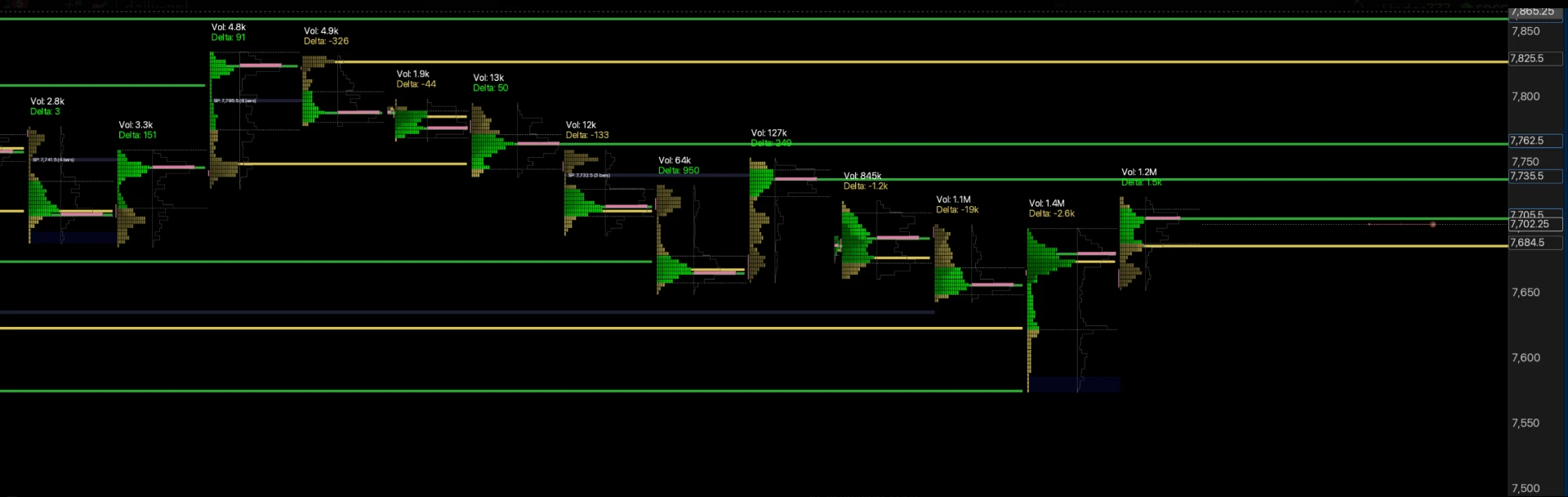
My levels identify areas to assess, not instructions to enter when price touches a line. Ask whether the reaction supports the original scenario or invalidates it. For the underlying concepts, read orderflow trading explained and my TradingView levels tutorial.
A six-question checklist for every trade you study
- Where is the trade happening? Identify the instrument, session and reference area. A setup is not independent of its location.
- What is the scenario? Write the expected behaviour in plain language: rejection, acceptance, continuation or no clear idea.
- What would invalidate it? Look for an observable condition rather than “I still feel bullish.”
- What triggered execution? Separate reaching the level from the evidence used to enter.
- How was risk managed? Note the stop logic, position changes and any reasons for exiting early.
- What remained uncertain? Record missing information rather than filling gaps with assumptions.
Do not invent a stop or size if the video does not show it. Mark that part of the review as unknown. Learning to recognise missing information is useful; constructing a perfect story around the outcome is not.
Why copying livestream entries changes the trade
The picture reaches you after the trader saw the market. Video processing, buffering and your connection add delay, which can vary during a session. Chat adds another layer. There is no reliable universal delay you can subtract from every broadcast.
By the time you hear an entry, price may have moved. Chasing it changes the distance to invalidation and the reward available before the intended target. Your contract, position size and available drawdown may also differ from the trader's.
Never manage an open trade by waiting for the next streamed update. Use your own market feed, orders and risk plan. If you cannot explain the trade without the broadcaster telling you what to do next, treat it as an observation rather than an execution opportunity.
Replay method: pause before the outcome is known
A recording gives you control of the pace. Pause before the decision, cover future candles if your chart allows it and write the evidence available at that moment. Choose what you would need to see—not what you now know happened.
Then watch the explanation and compare. Did the trader wait for confirmation you overlooked? Did they skip something you would have forced? Record one difference in reasoning. You are testing your interpretation, not competing with a historical P&L number.
Replays create hindsight bias: a move looks obvious once you know where it ended. Counter it by collecting multiple sessions and recording observations before pressing play. A replay review is educational practice, not a backtest proving a strategy's future returns.
A hypothetical ES review without a trade call
Imagine ES returns to an area you identified during preparation. Your idea is rejection, but price stays above the area and continues trading there. No prices or entry instructions are needed to review the decision: the question is whether the expected rejection appeared.
Pause the recording and write two branches. If price rejects with evidence you understand, assess the scenario within your own plan. If it accepts above the area or the evidence is unclear, abandon the fade idea or keep observing. A touch alone does not resolve the question.
Now watch what the trader did and why. If they skipped the trade, do not label it a missed opportunity because price later moved. If they lost, do not automatically label the original decision irrational. Evaluate the information available before the outcome.
What the tools and funded-account numbers mean
In my own workflow, ExoCharts is for orderflow analysis, TradingView connected to Tradovate is for execution, and Tradecopia copies my own lead-account trade across my other accounts. A screenshot of several account results can therefore show the same underlying decision repeated, not several independent setups.
Account limits still apply individually. Nominal account size, remaining drawdown and personal capital are different numbers. A copied position that fits one account can be unsuitable for another because their remaining loss allowances differ.
Do not copy aggregate contract size from the screen. Study the execution workflow in my prop firm trading setup, then check your firm's current rulebook and your own limits. Neither a public stream nor VIP supplies your platform subscriptions or exchange market data.
Live room, trading community and daily VIP preparation
A broadcast shows a session; a community gives you a place to discuss and review; daily preparation gives you the author's current scenarios and levels. They can complement each other, but they do not provide the same thing.
For a room's broader role, see what a live trading room provides. For asking useful questions afterwards, use my trading community participation guide. You can start with the free resources without buying anything.
Inside SATO VIP I share my daily ES/NQ trade setups, orderflow levels and market bias. The method has been backtested over five years; that does not guarantee future performance. You decide confirmation, execution and risk, and daily analysis does not guarantee an actionable trade every day. All tutorials remain free on YouTube.
Build a short review routine instead of watching all day
Choose one session segment around a question you are trying to answer. Review the preparation, watch the decision and write one lesson. Watching hours of charts without a question can feel productive while leaving your process unchanged.
Use a simple review note: session date, scenario, evidence, invalidation, decision and missing information. Return to it during your own simulator practice. Keep observations separate from recommendations and do not turn someone else's historical trade into a live position.
The aim is to understand why a trader waited, acted or stood aside. When that reasoning becomes clearer, the stream has done its job—even if the most useful lesson was a trade that never happened.
Last updated 2026-11-11. Futures trading involves substantial risk of loss. Public sessions are historical or occasional; no fixed streaming schedule or future results are promised.
Day Trading Live Stream FAQ
What is a day trading live stream?+
It is a broadcast of a trader's market analysis, execution or session commentary as it happens. Some broadcasts show actual trades; others show analysis only. A recorded livestream is a replay of a past session, not current market guidance.
Where can I watch day trading live with Sato?+
Check satotrades.com/live for current availability. Sato streams occasionally without a fixed daily schedule. Between streams, use the public SatoTrades YouTube archive, which contains three months of trading recordings across $1M+ in funded accounts.
Are Sato's live streams free?+
Yes. Public streams and recordings are free, and all tutorials are free on YouTube. SATO VIP is a separate optional paid membership for daily ES/NQ setups, orderflow levels and market bias.
Does Sato stream every trading day?+
No. Streams are occasional, not always live and not on a promised daily schedule. The daily ES/NQ analysis and setups shared in VIP are a different offer from public livestream availability.
Should I copy trades from a livestream?+
No. Video latency, different fills, position sizing and account constraints can make your trade very different. Use the broadcast to study reasoning. You remain responsible for your own confirmation, execution and risk.
Are trading recordings useful if I miss the live session?+
Yes. Pause before the decision, write what you would need to see and then compare with the trader's explanation. Replays let you review calmly, but knowing the outcome can create hindsight bias.
What should I look for in an ES or NQ stream?+
Look for the instrument and session, a clear area of interest, conditions for entry or no trade, invalidation, position management and an honest explanation of uncertainty. A profitable screenshot alone does not establish the quality of the process.
Does $1M+ in funded accounts mean Sato risks $1M?+
No. Nominal funded-account sizes are not the same as personal cash at risk or usable drawdown. Actual account rules and remaining loss allowances govern risk. Aggregate account size is not a promise of profits or returns.
What tools does Sato use in his trading workflow?+
Sato uses ExoCharts for orderflow analysis, TradingView connected to Tradovate for execution and Tradecopia to copy his own trades across accounts. Joining VIP does not include those software subscriptions or exchange data.
How is VIP different from watching a livestream?+
VIP contains my daily ES/NQ trade setups, orderflow levels and market bias. Public streams show occasional session execution and discussion; recordings show historical decisions. VIP analysis is context, not automatic signals, and does not guarantee an actionable trade every day.